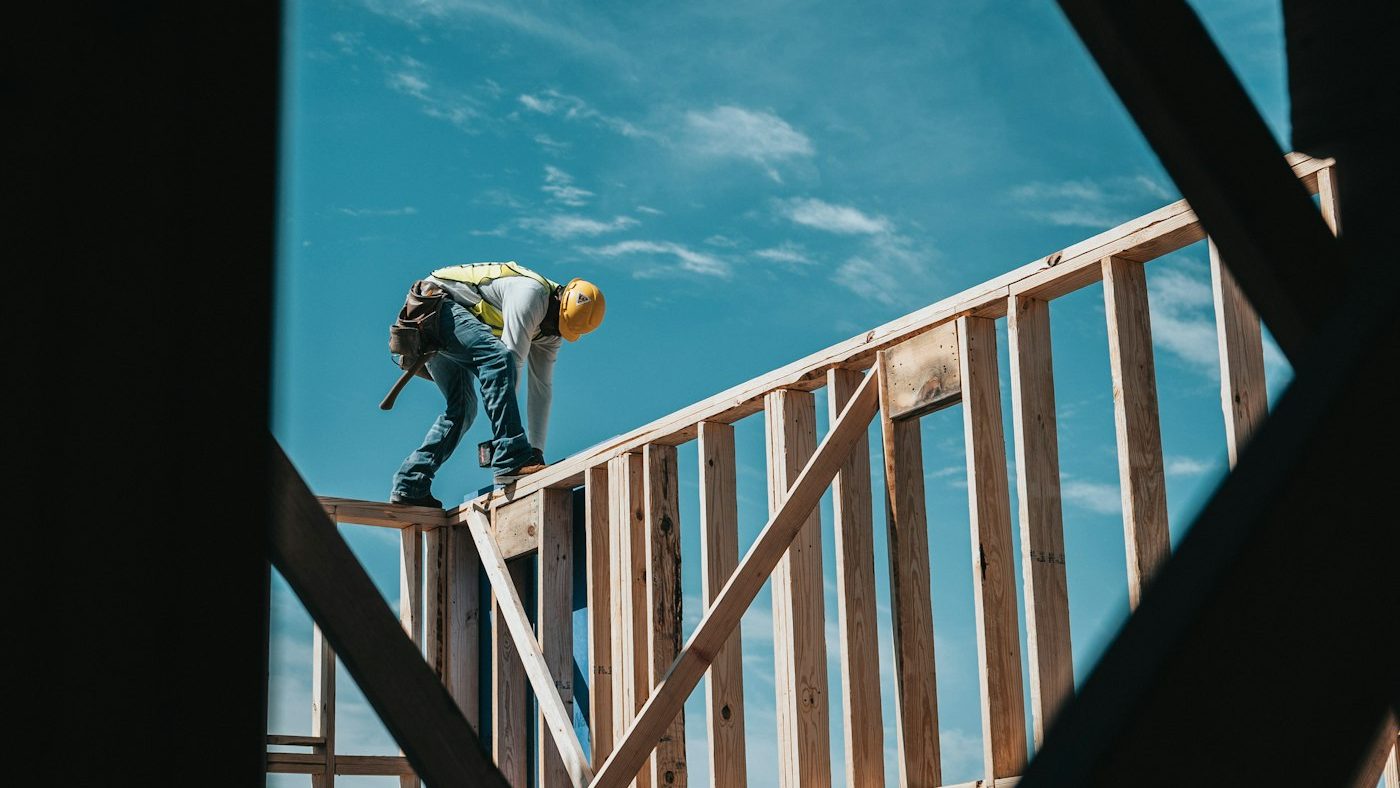
A framer works the top plate of a new wall. In the Greeley metro, one job in ten is in construction or extraction. Photo: Josh Olalde / Unsplash
Colorado had 186,400 construction jobs in August, according to seasonally adjusted BLS figures, a little below the 189,000 peak it reached in February and again in June. The state labor department counts about 2,200 more construction jobs than a year earlier, which makes construction the third-largest private-sector gainer in Colorado over the year. On paper, the industry is fine.
Ask the people who run crews and you get a different answer. The job count tells you how many people are working. It does not tell you how many more a contractor would hire tomorrow if they could find them, or how many jobs were never bid because the crew was not there.
What Colorado contractors are actually reporting
The Associated General Contractors and NCCER surveyed 1,830 firms this summer. Nationally, 87 percent have openings for hourly craft positions, and 88 percent say those roles are as hard or harder to fill than a year ago. That is in a market the same survey calls soft.
The Colorado results, reported by CPR, are worse than the national numbers on almost every line. Half of Colorado firms said applicants lacked basic credentials such as a driver’s license, a work permit or a clean background check, against 36 percent nationally. Nearly two-thirds said candidates lacked the skills for the job. Fourteen percent had applied for employment-based visas, double the national rate. And 46 percent had a project canceled, postponed or scaled back because of cost, against 34 percent nationally.
Nationally, the picture is the same shape. Associated Builders and Contractors estimates the industry must attract 349,000 net new workers in 2026 and 456,000 in 2027 just to keep up, most of it to replace people retiring. Among home builders, 61 percent called labor cost or availability a significant problem last year, and they do not expect 2026 to be different.
Why Greeley feels it first
Weld County is unusually dependent on the building trades. In the Greeley metro area, construction and extraction jobs number 11,870, or 9.9 percent of all employment. Nationally that share is 4.1 percent. In the Fort Collins–Loveland metro, it matches the national 4.1 percent.
Pay here trails the rest of the country. The mean construction and extraction wage in Greeley is $29.82 an hour, against $31.42 nationally. Construction laborers, 1,430 of them, average $23.66. Electricians average $32.32 and first-line trade supervisors $40.25. Fort Collins–Loveland runs slightly higher at $30.30. Statewide, average hourly earnings for all construction employees reached $41.52 in 2025, up from $37.73 a year earlier. A tradesperson in Weld can drive an hour south and earn noticeably more.
Half of Colorado contractors say applicants cannot clear the basics: a license, a work permit, a clean background check.
The immigration piece
The Colorado Fiscal Institute puts immigrants at 28 percent of Colorado’s construction workers. The American Immigration Council estimates that about 13 percent of the state’s construction workforce are immigrants without legal status. Nationally, NAHB counts immigrants at a record 26.3 percent of construction workers in 2024, and far higher in the finishing trades: 57 percent of drywall installers, 53 percent of roofers and painters, 43 percent of laborers and 35 percent of carpenters.
Enforcement has changed sharply. ICE made 4,160 arrests in Colorado in 2025, up from 1,091 in 2024, according to the Colorado Sun, and 65 percent of those arrested had no criminal conviction. In the AGC survey, 14 percent of Colorado contractors said immigration agents had visited one of their jobsites or offices in the past six months, more than twice the national rate.
The effect does not stay with the people detained. A study by CU Boulder economist Chloe East found that enforcement surges cut construction employment among U.S.-born workers with a high school education or less by about 3 percent. When a crew comes up short, the work around it stalls too.
The slow leak: retirements
The median construction worker is 42 years old. About 14.2 percent are 55 or older, and only 14.1 percent are under 25, so the pipeline coming in is roughly the size of the group about to leave. NAHB’s Home Builders Institute estimates the skilled-labor shortage costs the industry $10.8 billion a year and kept 19,000 homes from being built.
Costs have not stopped moving either
Building materials are up 6.7 percent over twelve months, according to NAHB. The median small builder saw a 9.1 percent increase, while large builders saw 1.8 percent, because volume buys leverage. Mortenson’s cost index for Denver is up 6.84 percent year over year, and the firm says the full effect of tariffs is not yet in its pricing.
Demand has softened a little. Seasonally adjusted single-family permits in the Greeley metro ran between about 200 and 260 a month through 2025 and fell to roughly 166 in July. That has not made crews easier to find, which tells you how tight the pool was to begin with.
A new competitor for electricians
On September 9, Weld County commissioners unanimously approved Global AI’s data center on the 438-acre former Kodak site near Windsor. The first phase is 27.5 megawatts, with plans for up to a gigawatt. Data centers are already pulling electricians and heavy trades away from other work nationally; the AGC survey singled them out. A build that size inside Weld will compete for the same electricians, operators and supervisors that every other contractor in the county is trying to keep.
Where the new workers might come from
Some of the answer is local. Greeley, Aims Community College and Alquist, a company that prints concrete structures, run a joint training program. More than 200 students have taken 3D-printing courses since 2025, and Alquist says its in-house training time dropped from about two weeks to two or three days. The company will move into Aims’ Workforce Innovation Center when it opens in January 2027. Statewide, Colorado registered more than 100 new apprenticeship programs last year.
What to do with this
If you are planning a building, a tenant finish or an expansion in the next two years, assume it will take longer than the bid says. Lock in subcontractors early, put material escalation terms in writing and build slack into any date that matters, such as a lease start or an equipment delivery. If you employ tradespeople, the data center and the wage gap to the south mean your people are getting calls; retention pay and a training path are cheaper than rehiring. And if you are short-handed, the programs at Aims and the state’s registered apprenticeships are a way to grow workers instead of bidding for the same ones as everyone else.
The construction labor squeeze at a glance
- Colorado construction jobs
- 186,400 (Aug. 2026, seasonally adjusted); peak 189,000
- Greeley trades share
- 9.9% of jobs vs 4.1% nationally
- Greeley mean trades wage
- $29.82/hr vs $31.42 nationally
- Applicants lacking credentials
- 50% of Colorado firms vs 36% nationally
- Projects cut or delayed for cost
- 46% of Colorado firms vs 34% nationally
- Immigrant share, Colorado construction
- 28%
- Denver construction costs
- +6.84% year over year
Sources
- Colorado Department of Labor and Employment, Employment Situation, August 2026 (Sept. 18, 2026)
- U.S. Bureau of Labor Statistics via FRED, Colorado construction employment (COCONS)
- U.S. Bureau of Labor Statistics, Occupational Employment and Wages in Greeley, May 2025
- U.S. Bureau of Labor Statistics, Occupational Employment and Wages in Fort Collins, May 2025
- U.S. Bureau of Labor Statistics via FRED, Colorado construction average hourly earnings
- Associated General Contractors and NCCER, 2026 workforce survey (Sept. 3, 2026)
- CPR News, Colorado construction and competition (Sept. 3, 2026)
- Associated Builders and Contractors, 2026 workforce shortage estimate (Jan. 15, 2026)
- National Association of Home Builders, builders’ top concerns for 2026 (Feb. 2026)
- Colorado Fiscal Institute, statewide economic contributions of immigrants (Feb. 2025)
- KUNC, immigration sweeps and Colorado construction (March 10, 2025)
- National Association of Home Builders, immigrant workers by state and trade (April 2026)
- Colorado Sun, immigration enforcement in Colorado in three charts (May 4, 2026)
- CU Boulder Today, ICE enforcement and U.S.-born workers (May 4, 2026)
- NAHB Eye on Housing, median age of construction workers (Oct. 2025)
- National Association of Home Builders, HBI labor market report (Oct. 10, 2025)
- National Association of Home Builders, building material prices (Aug. 2026)
- Mortenson, Denver construction cost index (Q3 2026)
- U.S. Census Bureau via FRED, Greeley MSA single-family permits
- CPR News, Weld County approves data center (Sept. 10, 2026)
- City of Greeley, Aims and Alquist workforce training (Sept. 8, 2026)
- Colorado Department of Labor and Employment, Apprenticeship Month 2026 (April 2026)
Weld just overtook Larimer. Here's who is moving in, and what it means for your business.
Weld added more residents last year than any county in Colorado and now outnumbers Larimer. Three of the state’s five fastest-growing cities are inside its borders.

Colorado's $7.5 billion venture boom is building factories up I-25.
Colorado venture funding hit $7.46 billion in 2025. The rounds are in Boulder and Denver; the manufacturing is showing up in Loveland, Berthoud and Longmont.
A Class 4 roof costs a few thousand more. Here’s when it actually pays you back.
Impact-resistant shingles add $2,000 to $5,000 to a re-roof. Insurer discounts run from 5 to 25 percent, none of the shingles IBHS tested earned its top score, and state grants start in 2027 at the earliest.
Get In Touch
Want to be in the magazine?
Send us a story idea, an interview request or an event. We hear from owners, chambers and industry groups all over Weld, Larimer and Boulder counties. It costs nothing and we decide what runs.
Pitch a Story