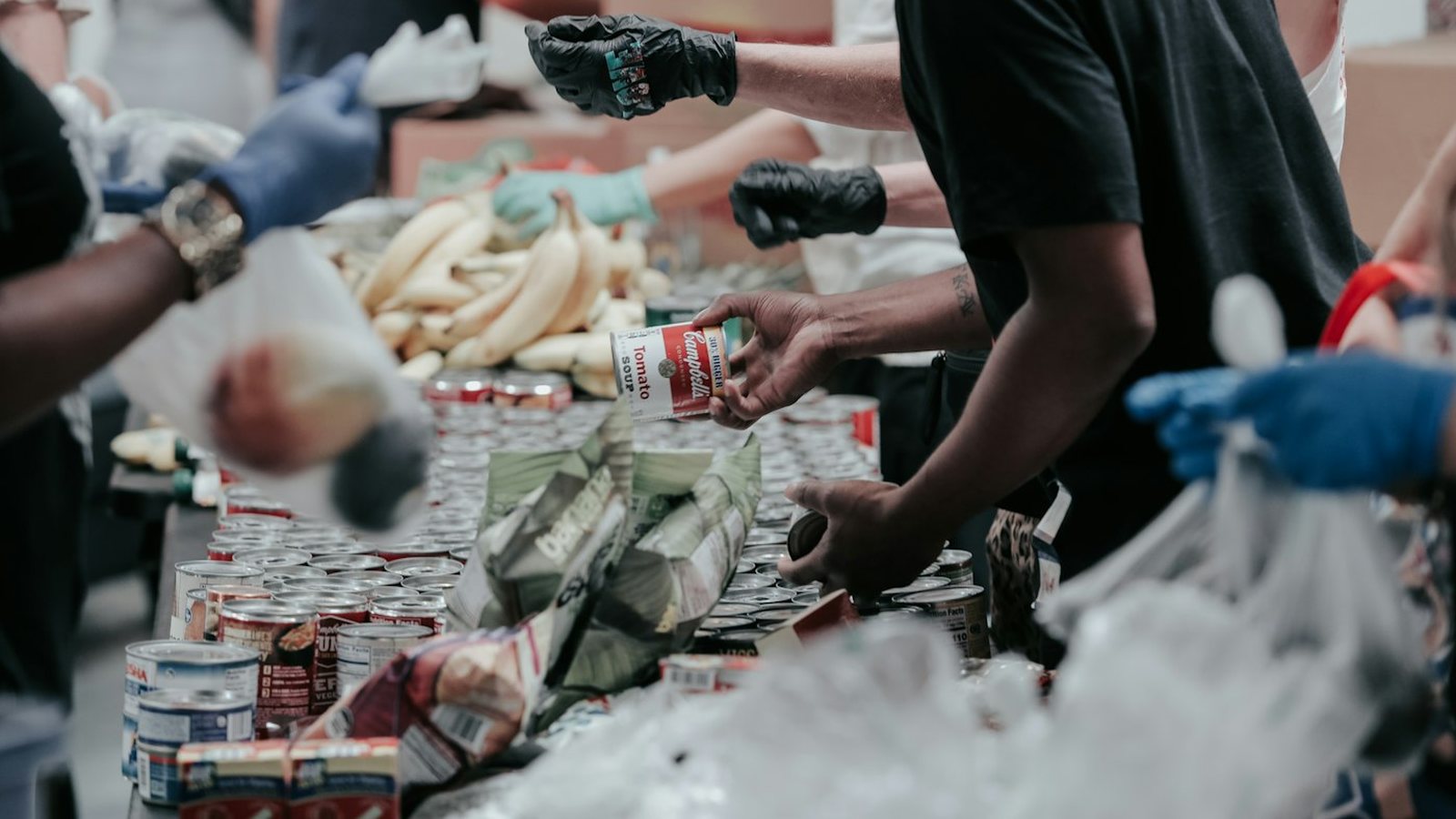
Volunteers sort canned donations into household boxes at a food distribution. Photo: Joel Muniz / Unsplash
Five years ago the Weld Food Bank spent roughly $400,000 a year buying food. In 2025 it spent close to $4 million. Nothing about that tenfold increase is a story about generosity drying up. It is a story about where the food used to come from, and why it stopped.
For a business owner in Greeley or Windsor, this matters in two directions: your employees are more likely to be affected than you would guess, and the kind of help that actually moves the needle has changed.
How bad it is, and the trouble with saying so
Three different organisations measure food insecurity in Colorado and none of them agree. The USDA's survey put the state at 10.8 percent across 2022 to 2024, comfortably below the national average. Feeding America's modelled estimate put Colorado at 12.7 percent for 2023. The Colorado Health Access Survey, which asks different questions, put the state at 11.2 percent and Weld County at 21.4 percent — up from 13.4 percent in 2021.
Those are not comparable numbers and anyone presenting them as one trend line is doing it wrong. What they agree on is direction. In Greeley-Evans District 6, 66 percent of students qualify for free or reduced lunch. In Fort Lupton, 65 percent.
The supply side collapsed before the demand side rose
The Emergency Food Assistance Program is the federal channel that sends commodity food to food banks. Cuts starting in April 2025 hit hard: Care and Share, the southern Colorado regional bank, reported a 37 percent decline in that supply, about four million meals. The same reporting put Weld Food Bank's funding gap at $2 million.
Separately, in March 2025 the USDA cancelled the Local Food for Schools and Local Food Purchase Assistance programmes, which paid food banks and school districts to buy directly from nearby farms. Colorado had received more than $14 million over three years and had $13 million allocated for 2025. Food Bank for Larimer County had about $500,000 of it; Greeley-Evans District 6 about $238,000. That money was buying Colorado produce.
Demand went the other way. Weld Food Bank reported a 230 percent increase in emergency food programme visits and roughly 30,000 visits a month in 2025, against a projected $700,000 shortfall. It distributes about 14.5 million pounds a year through roughly 70 agency partners on a cash operating budget near $6 million, serving more than 88,000 people. Across the county line, Food Bank for Larimer County moved about 9.5 million pounds and helped 1,814 households apply for SNAP, which it estimates pulled $6.5 million of federal money into the local economy.
The constraint is no longer shelf space. It is purchasing power — which makes a cheque worth more than a canned-goods drive, and makes that an awkward thing to tell your staff.
Two deadlines in the next two years
Colorado's SNAP programme covered 614,911 people as of October 2025, about half of them children, at an average $367 per household per month. Two changes are scheduled. The state's administrative match rises from 50 to 75 percent in October 2026, roughly $50 million. Then in October 2027 a benefit cost-share begins, and because Colorado's payment error rate sits just under 10 percent, the state is on the hook for about 10 percent of benefit costs — something like $130 million a year. If the error rate crosses 10 percent, that becomes 15.
The 2025 federal law also extended work requirements to older adults and to parents of children over 14. Practically, that means some of your hourly staff will lose benefits while still employed. The state health survey found 11.8 percent of *employed* Coloradans are food insecure.
School meals are on your tax return
Healthy School Meals for All, which makes breakfast and lunch free in every participating Colorado school, is funded by capping deductions for filers with adjusted gross income above $300,000 — which is to say, by a good number of the business owners reading this. Voters approved it in 2022, then approved Propositions LL and MM in November 2025 to keep it funded after participation ran far ahead of projections. The programme needs about $150 million a year.
It is already back in trouble. Analysts now expect Proposition MM to raise about $101 million against the $95 million voters authorised, and under TABOR the excess has to be refunded or re-approved. Expect this line on your state return to keep moving.
What actually helps
One thing to know first: Colorado's crop and livestock donation tax credit expired after tax year 2022. If your accountant still mentions it, the advice is stale. The only live state credit in this area is the Community Food Access Tax Credit, running 2024 through 2030, and it is aimed at distribution logistics and small food retailers rather than donations.
What is left is straightforward. Cash goes furthest, because the bottleneck is purchasing power. If you have surplus edible product, Food Bank of the Rockies' rescue network already moves 49 million pounds a year from more than 880 donor locations and publishes a direct line for businesses wanting to join. If you want your team out of the building, Weld Food Bank takes business volunteer groups in three formats with shifts from 7:45 a.m. to 4 p.m. and evening packing. JBS funded a delivery truck for them through its Hometown Strong programme; Greeley contractor Hensel Phelps runs food drives and volunteer days.
And if you are choosing between counties: Weld's food bank runs on roughly $6 million in cash in the faster-growing, harder-hit county, and has no announced capital campaign. Larimer finished its $9.1 million distribution centre in 2019. A dollar goes further in Weld right now.
At a glance
- Weld food insecurity
- 21.4% (2023 state health survey), up from 13.4% in 2021
- Weld Food Bank
- ~14.5M lbs/yr, ~70 partners, ~$6M cash budget, 88,000+ served
- Purchased food
- ~$400,000/yr five years ago to nearly $4M in 2025
- Federal supply
- TEFAP down sharply; LFS and LFPA cancelled March 2025
- SNAP deadlines
- Admin match rises Oct 2026; benefit cost-share begins Oct 2027
- Donation tax credit
- Crop/livestock credit expired after 2022
Sources
- USDA Economic Research Service, Household Food Security in the United States in 2024
- Feeding America, Map the Meal Gap (Colorado, 2023)
- Colorado Health Institute, 2023 Colorado Health Access Survey
- The Weld Trust, Food Security report (Dec. 2025)
- CBS Colorado, Weld Food Bank donations (Oct. 13, 2025)
- CPR News, Colorado food banks supply and demand (Aug. 27, 2025)
- KUNC, USDA local food funding cuts (March 18, 2025)
- BizWest, new chief executive at Weld Food Bank (April 7, 2026)
- Food Bank for Larimer County, About Hunger
- Colorado Sun, SNAP and the federal shutdown (Oct. 22, 2025)
- Colorado Fiscal Institute, the SNAP cost shift
- Colorado Sun, Proposition MM results (Nov. 4, 2025)
- Colorado Sun, Proposition MM and TABOR (Jan. 5, 2026)
- Urban Institute, Healthy School Meals for All in Colorado (Dec. 2024)
- Colorado Department of Revenue, income tax credits
- Food Bank of the Rockies, food rescue programme
- Weld Food Bank, group volunteering
- JBS Hometown Strong, Colorado projects

If software touches your hiring, Colorado's new AI law applies to you. The clock starts January 1.
SB 26-189 repealed the 2024 AI Act and replaced it with a lighter framework. The impact assessments are gone. The notice duties are not, and they reach employers of every size.

Weld just overtook Larimer. Here's who is moving in, and what it means for your business.
Weld added more residents last year than any county in Colorado and now outnumbers Larimer. Three of the state’s five fastest-growing cities are inside its borders.
Colorado's $7.5 billion venture boom is building factories up I-25.
Colorado venture funding hit $7.46 billion in 2025. The rounds are in Boulder and Denver; the manufacturing is showing up in Loveland, Berthoud and Longmont.
Get In Touch
Want to be in the magazine?
Send us a story idea, an interview request or an event. We hear from owners, chambers and industry groups all over Weld, Larimer and Boulder counties. It costs nothing and we decide what runs.
Pitch a Story